

A friend asked me:
"Which one habit has had the biggest impact on your life?"
I couldn't answer.
Not because I don't have impactful habits, but because the question misses the point.
One habit doesn't transform your life. A system of aligned behaviors does.Here are seven that actually moved the needle.
Not because they're revolutionary, but because I actually did them instead of just reading about them.
1. Phone Out of Bedroom
This isn't a productivity hack. It's a nervous system reset.
What changed:
Mornings: Calm instead of anxious
Nights: Tired instead of wired
Days: Present instead of reactive
Buy a $10 alarm clock.
Keep your phone in another room.
You won't do this.
You'll think about it, agree it's smart, then keep your phone on your nightstand because you "need it for emergencies."
That's the pattern showing itself.
Comfort over change.
2. The 5-Minute Rule
When you don't feel like doing something, commit to 5 minutes.
Write for 5 minutes.
Clean for 5 minutes.
Exercise for 5 minutes.
Why this works:
Starting is the hard part. Continuing is natural.
The real insight isn't the 5 minutes, it's that you're negotiating with resistance instead of trying to overpower it.
Most people either force themselves through willpower (unsustainable) or avoid entirely (ineffective).
This creates a third option:
Low-commitment entry that usually leads to full engagement.
3. Increase Your Luck Surface Area
Luck = Randomness × ReadinessMost people wait for luck. A few manufacture it.
How:
Start conversations with strangers
Share work publicly
Attend events outside your routine
Keep skills sharp
Always have a project running
Ask directly for what you want
Reality check:
You're not unlucky.
You're invisible.
You're not taking enough shots, and when opportunities appear, you're not prepared.
4. Walk Without Your Phone
Once a day, walk outside without your phone.
No podcast.
No music.
No checking at stoplights.
This is where your best ideas live.
Not in the next article you consume, but in the space between consumption and creation.
Your brain needs boredom to process.
You're not giving it that space.
5. Weekly Accountability Partner
Every Sunday, call someone and review:
What you said you'd do
What you actually did
Why this matters:
You'll follow through on commitments to others even when you won't follow through for yourself.
This single habit outperforms every app, tracker, and motivation technique combined.
The uncomfortable truth:
You don't need better systems.
You need social pressure that makes breaking commitments painful.
6. Track What You Want to Change
What gets measured gets managed.
Want to fix finances? Track them.
Want to fix diet? Track it.
Want to fix habits? Track those.
You can't change what you're not aware of.Most people avoid tracking because tracking reveals patterns they don't want to confront.
How much they actually eat.
How much they actually spend.
How little they actually work on what matters.
Ignorance feels comfortable. Awareness demands action.7. Block Everything on Your Calendar
Everything gets a time slot:
work, exercise, personal projects, rest.
This isn't rigid - it's liberating.
Time blocking:
Shows you where time actually goes
Forces focus on one thing at a time
Prevents overcommitment
The pattern most people have:
Optimistic about future capacity, overwhelmed by present reality.
Time blocking makes capacity visible before you overcommit.
Why You Won’t Do Any of This
You’ll read this list.
You’ll nod.
You’ll think, “I should try that.”
Then you’ll do nothing.
Why?
Because reading about habits gives you the dopamine hit of improvement without requiring actual change.
You’re consuming content about habits instead of implementing one.
The gap between your current life and the one you want isn’t information.
It’s execution.The typical advice here is
“Pick one habit and commit for 7 days.”
But that’s a weak intention.
It relies on willpower, and willpower is the first thing to break.
We’re not going to do that.
We’re going to build a system.
We will make execution strategic.
Here is the real challenge.
The 3-Step Execution Framework
Step 1: Identify Your Leverage Point, Not the “Easiest” Habit
“Pick one habit” is arbitrary.
A strategist targets the bottleneck.
Analyze the 7 habits.
Which one, if implemented, would create the most positive cascade effect and make the others easier?
Example: If your primary issue is a reactive/anxious mind, #1 (Phone Out of Bedroom) is your leverage point.
Example: If your primary issue is chaotic planning, #7 (Time Blocking) is your leverage point.
Choose the habit that addresses your root cause, not the most appealing symptom.
Step 2: Design Your System Protocol
“Committing” is vague.
A protocol is a non-negotiable set of rules.
For the single habit you selected, define the full system.
Triggers: What specific time or event initiates the habit?
(e.g., “When my 10 PM alarm rings,” “The moment I finish lunch.”)
Environment: What physical changes will you make to make the habit inevitable?
(e.g., “Buy the $10 alarm clock and put it in the bathroom,” “Pre-block my calendar for Sunday night.”)
Failure Protocol: What is the immediate, non-emotional consequence when you fail?
This is not punishment; it’s an interceptor to prevent one failure from killing the system.
(e.g., “If I fail to track my finances, I must immediately...”).
Step 3: Install an Inescapable Forcing Function
This is the most important step.
We will remove your willpower from the equation and install a hard external constraint.
Option A (Social): Use #5 (Accountability Partner).
Send them your 7-day protocol and $100.
If you miss a single day without executing the failure protocol, they keep the money.
Option B (Public):
Post your commitment and full protocol publicly (LinkedIn, Twitter, etc.).
The social cost of failure is now higher than the comfort of avoidance.
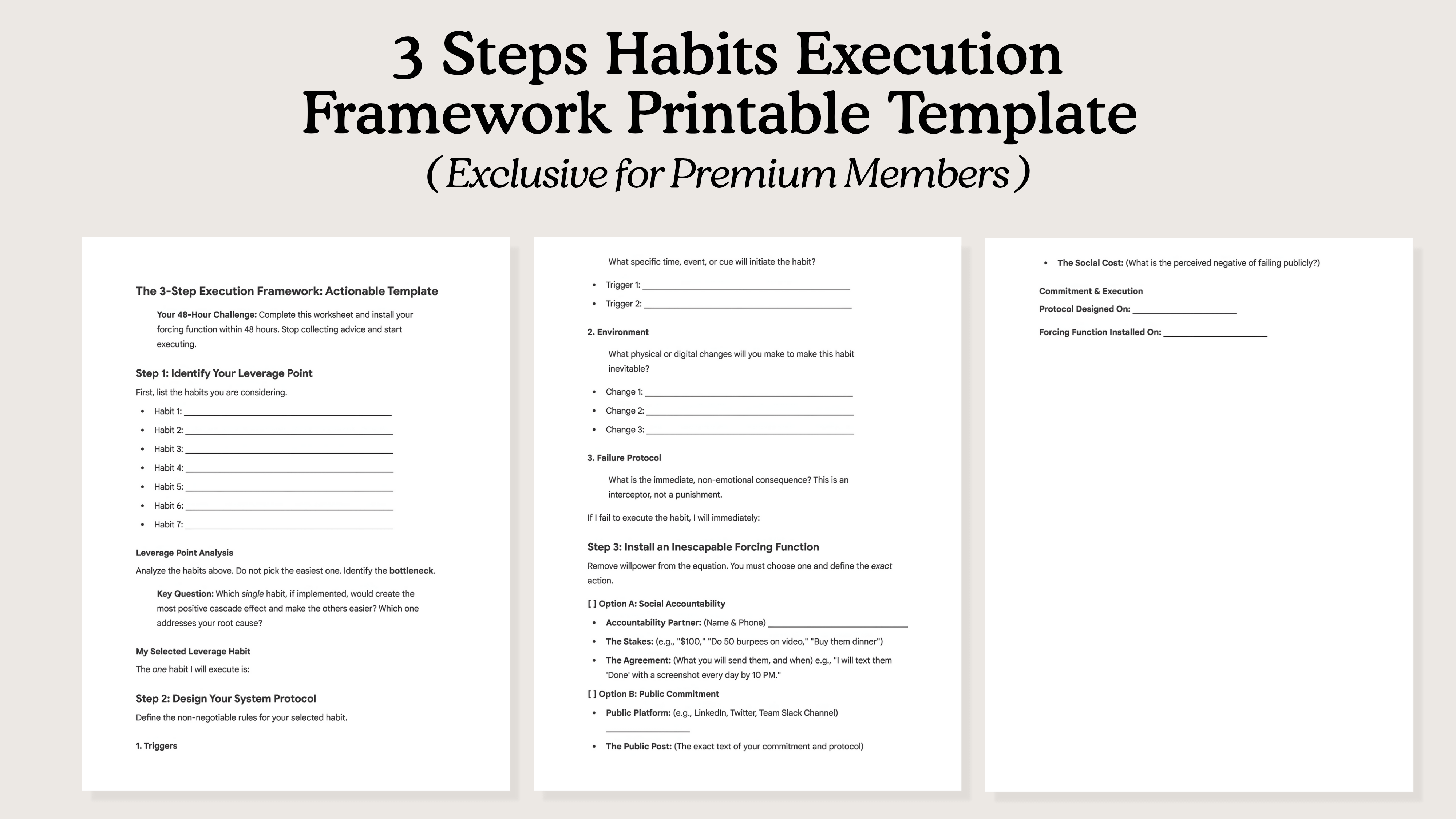
3 Steps Habits Execution Framework Actionable Printable Template »»»»
Your 48-Hour Challenge
You have 48 hours to complete the following:
Select your single, highest-leverage habit.
Design the full System Protocol (Triggers, Environment, Failure Protocol).
Install your Forcing Function (Accountability Partner or Public Commitment).
Stop collecting habit advice. Start executing on the habits you already know matter.
Your move.
Before you go: Here are 3 ways I can help
#1 Premium Newsletters FREE Access - Free access of the Premium Newsletters reading by top 1%, exclusive for Elevated Path readers.
#2 Elevated Path Premium - Strategic & Actionable approach on Elevate Letters, exclusive templates & frameworks and FREE access to all Premium Paid Products.
#3 Actionable Printable Template - 3 Steps Habits Execution Framework Actionable Printable Template .
Untill next letter
~ Elevated Path
P.S. If you’re thinking, “I’ll start this after I finish my current commitments,” that’s the pattern.
There will always be “current commitments.”
The real question is whether you’re committed to staying the same or committed to changing.