


When someone sees potential in you,
It changes how you see yourself and how you show up.
This is known as the Pygmalion effect.
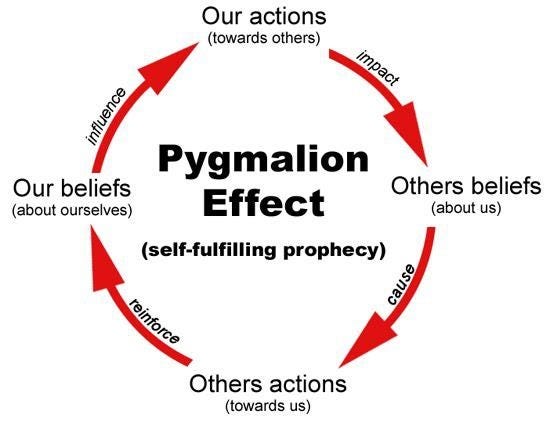
It means people often live up to the expectations others have of them.
Which means what we believe about others shapes how we treat them, which shapes how they see themselves, which ultimately shapes how they show up.
This creates a self-fulfilling prophecy loop.
Your belief → Your behavior → Their self-perception → Their performance → Confirmation of your belief.
The cycle reinforces itself in either direction—positive or negative.
The Leader’s Greatest Leverage
As a leader, this is by far your greatest leverage.
Not throwing a pizza party every other Friday.
This connects directly to tribal leadership psychology.
Leaders who create psychological safety allow people to believe in their own capabilities.
That belief unlocks performance that rewards and perks never could.
Transforming Belief
When Tom Cruise looks at Rooster and says, “You got this.”
He’s not just offering encouragement.
He’s transforming belief.
Because when someone believes in you, you start to believe it, too.
The phrase “You got this” does three things simultaneously:
Expresses confidence in their capability
Transfers responsibility to them (signaling trust)
Creates a mental anchor they can return to under pressure
It’s not motivation. It’s identity installation.
Why This Works
Your brain takes social feedback as data about reality.
When someone you respect believes in your capability, your brain updates its self-assessment.
“If they see it, maybe it’s true. Maybe I can.”
This is why psychological safety matters.
People can’t access their potential when they’re defending against judgment.
Belief from others creates the safety needed to take risks.
The Application
The next time someone on your team faces a challenge, don’t just say “good luck” or “try your hard.”
Look them in the eye and say, “You got this.” Mean it.
Watch what happens.
Your belief becomes their reality.
~ Elevated Path